November, 2025
A new scientific milestone has been published in Physical Review Research, co-authored by our CEO Stefano Pirandola, offering breakthrough insights into routing for large-scale quantum networks. This work delivers meaningful advances that align directly with nodeQ’s mission: enabling a robust, scalable quantum network infrastructure.
Why this matters:
In classical communications, network routing is effectively solved – we know how to move packets around the internet using well-understood protocols. But when it comes to quantum communications – transmitting entanglement, quantum states or secret keys across long distances – things become fundamentally different. The paper identifies that a point-to-point quantum channel inevitably suffers an exponential drop in rate with distance due to the underlying physics. Therefore, the promise of a quantum internet hinges on moving beyond simple direct links into networked quantum architectures.
What the paper reveals:
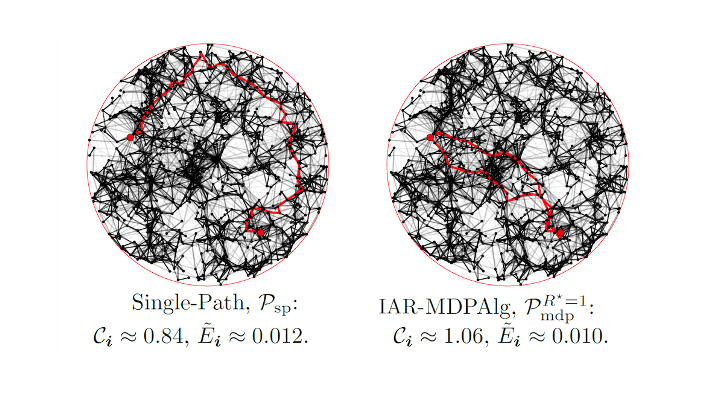
- Using realistic models of large optical-fibre quantum networks, the study models random network topologies and evaluates how different routing strategies perform.
- The authors propose and evaluate an advanced multi-path routing algorithm which efficiently splits quantum traffic over multiple parallel paths, aggregating the flows to boost overall throughput and resilience. The paper demonstrates that this multi-path approach offers significant performance improvements while also optimising resource use (i.e., reducing costly quantum hardware overhead).
- The authors also identify “critical phenomena” in the context of large‐scale quantum networks: threshold effects where network performance sharply degrades unless routing and topology are designed appropriately. These insights are essential for the architecture of a future quantum internet.
Implications for nodeQ and the industry:
For nodeQ, this work reinforces several of our strategic directions:
- Network architecture matters: it’s not enough to build quantum link by quantum link — the full network topology and routing strategy must be designed from the outset.
- Routing innovation is vital: we need to implement more advanced algorithmic strategies to support high‐rate, long‐distance quantum communications.
- Scaling quantum networks is more complex than the classical case: quantum networks have distinct failure modes and non-linear phenomena (the “critical” aspects). nodeQ’s work in building quantum network middleware, orchestration layers and digital-twin modelling is well aligned with meeting these challenges.
- Competitive advantage: By being at the forefront of this research, nodeQ strengthens its positioning as a thought-leader in quantum communications — not just a vendor, but a contributor to foundational science and engineering.
This research is an important milestone for the quantum communications community and a validation of nodeQ’s strategic focus on network-scale quantum systems. At nodeQ, we remain committed to translating these scientific advances into real-world infrastructure.